Pre-Partnership: Lessons Learned
I am not a professional investor. I work as a data engineer. But over the past five years, I have managed my own money in individual stocks, and the results have been better than I expected. I share them not to boast but to establish that what follows comes from actual experience, not theory.
Annualized Returns (as of December 16, 2025)
| 1 Year | 3 Year | 5 Year | |
|---|---|---|---|
| My Portfolio | +85.7% | +60.2% | +35.6% |
| S&P 500 | +15.0% | +20.5% | +15.2% |
| Difference | +70.7 | +39.7 | +20.4 |
These numbers could be luck. Five years is not that long, and I have made plenty of mistakes along the way. But certain lessons repeated themselves often enough that I began to trust them. Here are nine things I learned.
1. Cash is the real risk
Early on, I thought holding cash was safe. If I could not find a good idea, I would sit in short-term Treasury bills and wait. This felt prudent.
Then I learned about inversion—a concept I picked up from Charlie Munger. The idea is simple: instead of asking "what should I do to succeed," ask "what would guarantee failure, and how do I avoid that?"
Applied to investing, the question becomes: what guarantees I will not beat the market? The answer is obvious. Every percentage point the S&P 500 outperforms Treasury bills is a percentage point of potential return I leave on the table. The opportunity cost compounds.
This reframing changed everything. I stopped treating cash as a safe harbor and started treating the S&P 500 as my default. When I do not have a high-conviction idea, I own the index. It is not exciting, but it keeps me in the game. The discipline, I found, was not in finding things to buy. It was in resisting the urge to buy things I did not understand just because I felt I should be doing something. Most of the time, I did nothing—I just owned the index and waited.
2. Retail investors have real advantages
I used to think professional investors had all the advantages: better data, smarter colleagues, more resources. Some of that is true. But over time I realized that being a retail investor came with edges I had not appreciated.
I have no quarterly performance reviews. No one is going to fire me for underperforming for eighteen months. I do not have to explain my positions to a committee or justify why I am holding something that is down forty percent. I can be patient in ways that professionals often cannot.
I also have no career risk. A fund manager who concentrates in a single stock and loses big might never work again. If I make a bad bet, I learn from it and move on. This freedom to be wrong without professional consequences is underrated.
And crucially, I am not forced to play. A professional manager cannot sit in the S&P 500 while waiting for a good idea—that is not what clients pay for. They must always be doing something, always finding the next opportunity, even when none exists. Forced action is a disadvantage. I can wait.
I can also invest in smaller companies that institutions cannot touch. A $500 million market cap stock might be too small for a large fund to build a meaningful position, but it can move the needle for me.
These are real advantages. I try not to waste them by mimicking what professionals do.
3. Concentration worked better than diversification
The standard advice is to diversify. Own many stocks so that no single mistake can hurt too badly. This is reasonable advice for most people.
But I found that concentration worked better for me. Not because I am smarter than the market, but because I only have so many good ideas. Spreading money across thirty stocks meant diluting my best ideas with mediocre ones. It also meant owning things I had not really researched—which is just a way of pretending to be diversified while actually being ignorant.
When I had genuine conviction—when I had done the work and believed I understood a business—I sized the position accordingly. Sometimes that meant forty or fifty percent of my portfolio in a single stock. This is not comfortable. And to be clear, it has also hurt me. I have held concentrated positions that went nowhere for years. But the alternative was owning things I did not really believe in, which felt worse.
The key, I think, is that concentration forces honesty. Putting half of a portfolio in one stock demands genuine understanding. Diversification can be a way of hiding from that work.
4. Buy what can be observed, at points of pessimism
My best investments were never clever macro calls or complex financial analyses. They were simple observations about businesses I could see with my own eyes.
I noticed a restaurant chain with long lines and happy customers. I saw a retailer where my wife kept shopping even when she said she would stop. I watched friends develop habits around certain products —coming back again and again, almost compulsively.
These businesses shared something I started calling "addiction" qualities. Not literal addiction, but habitual consumption driven by emotional attachment. The customers were not making rational cost- benefit calculations each time. They just kept coming back.
The thesis for these investments could fit in one sentence. If I needed a spreadsheet to explain why a stock was attractive, I probably did not understand it well enough. Sticking to businesses I could directly observe—as a customer, or by watching customers—kept me honest about what I actually understood versus what I was guessing at.
The second part was price. I used 52-week lows as a starting point—a rough indicator that pessimism had set in. But the low itself was not the signal. The work was determining whether the pessimism reflected temporary weakness or permanent damage. A bad quarter, a missed guidance, general market fear—these create opportunities. A broken business model or secular decline does not. The 52-week low got my attention; the analysis determined whether I acted.
5. The hard part is psychological
I thought investing would be an analytical challenge. Find undervalued stocks, buy them, wait for the market to recognize the value, sell. The numbers would tell me what to do.
I was wrong. The hard part was not analytical. The hard part was emotional—and it never let up.
Buying felt uncomfortable. My best investments made me nervous at the time of purchase. Something was wrong—or appeared to be wrong—with the company. The stock was down significantly. The news was bad. Analysts were skeptical. Buying felt contrarian, even foolish. I questioned myself. But this discomfort was the point. If a stock felt like an obviously great buy, everyone else saw it too, and the price already reflected that optimism.
Holding felt uncomfortable too. Watching a stock drop thirty percent after buying it. Reading negative articles and wondering if I missed something. Seeing friends make money in stocks I passed on. The temptation to check prices constantly, to trade, to do something. Every instinct says to react—to sell what is falling, to chase what is rising, to do anything other than sit still.
And the worst part: being early and being wrong feel identical. Buy a stock and watch it drop another twenty percent—there is no way of knowing in the moment whether the thesis was flawed or simply early. Sometimes I was not early. I was just wrong. But enough times I was right.
Richard Thaler won a Nobel Prize for showing that humans do not behave like the rational actors economists once assumed. We panic, we herd, we overreact. This is one of the reasons good businesses occasionally trade at throwaway prices. The same force that makes buying and holding uncomfortable is the force that makes the opportunity possible.
6. Ignore the macro
For years I tried to incorporate macroeconomic thinking into my investment process. Interest rates, inflation, Fed policy, GDP growth, unemployment—I read about all of it. I thought understanding the big picture would help me make better decisions.
It did not. I was convinced rates would stay low forever, then they rose. I was sure inflation was transitory, then it was not. I thought a recession was imminent at least three times when none arrived.
Looking back, almost none of my macro views turned out to be useful. The economy is too complex, and even correct predictions about macro trends rarely translate cleanly into stock prices.
What mattered was whether the specific business I owned was executing. Were same-store sales growing? Was the company gaining or losing customers? Were margins stable? These questions had answers I could actually find. The macro questions did not.
I still read the news. I am not suggesting ignorance. But I stopped letting macroeconomic views drive my investment decisions. The signal-to-noise ratio was too low.
7. Avoid leverage
This one is simple, and perhaps obvious, but worth stating: I do not use leverage.
Borrowed money magnifies returns in both directions. When right, leverage makes an investor look like a genius. When wrong, it can wipe out entirely. The asymmetry is unfavorable.
More importantly, leverage destroys patience. Own a stock with borrowed money and watch it drop forty percent—a margin call may follow. Forced to sell at the worst possible time, not because the thesis was wrong, but because waiting is no longer affordable. Leverage takes away the one advantage retail investors have: the ability to be patient.
I have found that avoiding leverage gave me the freedom to hold through drawdowns, to wait for my thesis to play out, to do nothing when doing nothing was the right move. That freedom was worth more than any amplified return.
8. Tax efficiency matters more than most think
I did not think much about taxes when I started investing. Returns were returns—what difference did it make if some went to the government? This was foolish.
A lot, it turns out. The single biggest thing I did for my long-term wealth was converting my retirement accounts to Roth. The math is simple: pay taxes now at today's rates, then let the money compound tax- free forever. No taxes on the gains. No required minimum distributions. No wash sale restrictions.
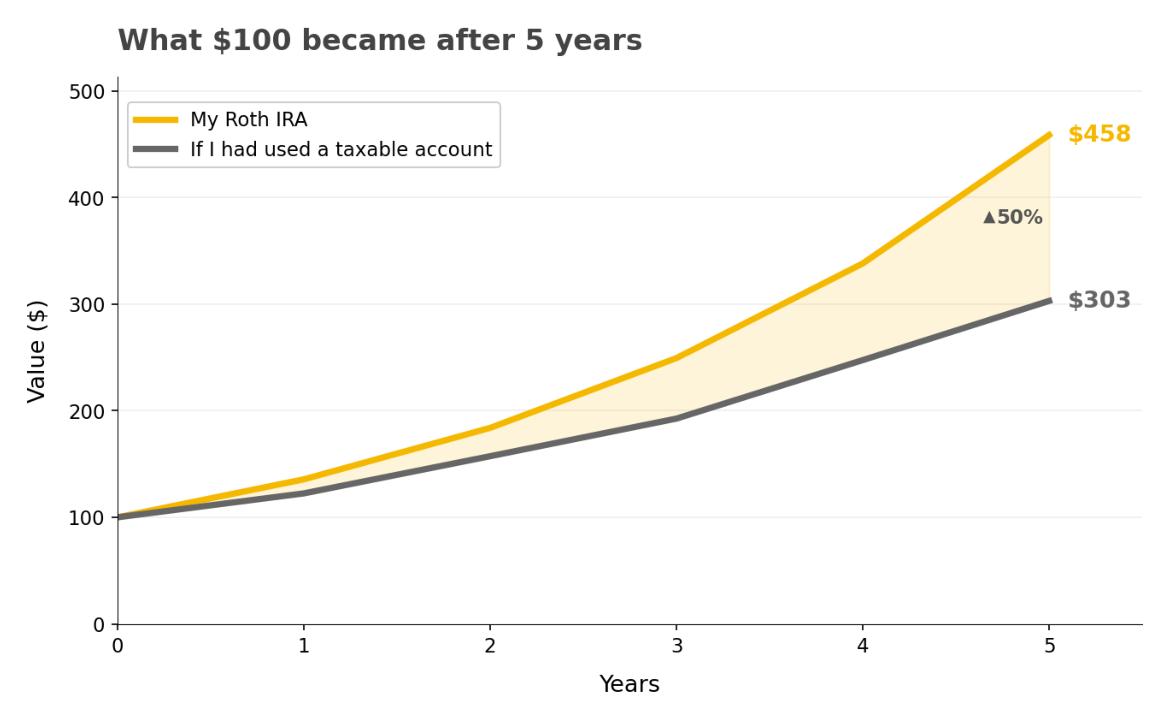
At my returns, every $100 in my Roth became $458 after five years. The same $100 in a taxable account—paying taxes on gains along the way—became only $303. The Roth wrapper gave me 50% more. For anyone who believes their investments will grow substantially, a Roth conversion is one of the few guaranteed ways to improve the outcome.
9. Lock in gains and return to the market
Most of my returns came from a handful of positions. This is consistent with what others have observed—the distribution of stock returns is highly skewed, and a few big winners drive most of the performance.
But knowing when to sell those winners was harder than I expected. The instinct is to hold on. If a stock has doubled, maybe it will double again. And sometimes it does. I have held winners too long and watched them round-trip back to my purchase price. That is a particular kind of pain—having been right, then giving it all back.
I learned that cycling back to the S&P 500 after a thesis played out was often the right move. The goal is not to maximize any single position. The goal is to compound wealth over time. Sometimes that means locking in the alpha—taking the gains that beat the market—and returning to the index while waiting for the next idea. This felt anticlimactic, but it worked.
A final note
These lessons come from my experience. They may not apply to everyone. Markets change, and what worked in the past may not work in the future. I have been fortunate in many ways, and I am aware that five years is still a relatively short time in investing.
But if there is one theme that runs through all of this, it is patience. Patience to wait for the right opportunity. Patience to hold through volatility. Patience to let compounding do its work. Most of what I learned can be reduced to variations of that single idea.
I hope some of this is useful. I am still learning.