Money and Happiness
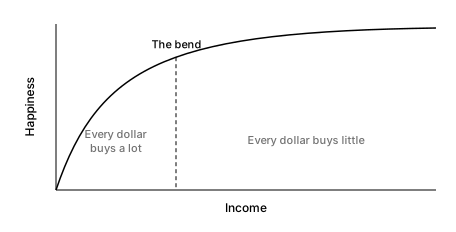
Kahneman and Deaton studied 450,000 people and found a curve. Day-to-day happiness rose with income, steeply at first, then barely at all.
Sahil Bloom counts five kinds of wealth: time, social, mental, physical, financial. Only the last has a number on it, so it is the one that gets chased. The usual way to earn it is to spend the other four.
Put the two together and you get a sequence, not a verdict. Before the bend, trading sleep, friends, and time for money is a fair trade. Every dollar there buys something real. After the bend, the same trade is a bad one. You are giving up what is scarce for what buys less and less.
There is a second reason to stop, and it is the one this site is about. Past the bend, money has a property the other four do not: it grows on its own. A portfolio compounds while you sleep. Your health does not. Your friendships do not. Time runs the other way. Once the pile is large enough to compound, it no longer needs to be fed. It needs to be left alone.
We believe in this sequence. Chase money until the curve bends. Then let it compound, and turn your attention to the four kinds of wealth that will not compound without you.
References
Kahneman, D., & Deaton, A. (2010). High Income Improves Evaluation of Life but Not Emotional Well-Being. Proceedings of the National Academy of Sciences, 107(38), 16489–16493. Bloom, S. (2025). The 5 Types of Wealth. Ballantine Books.